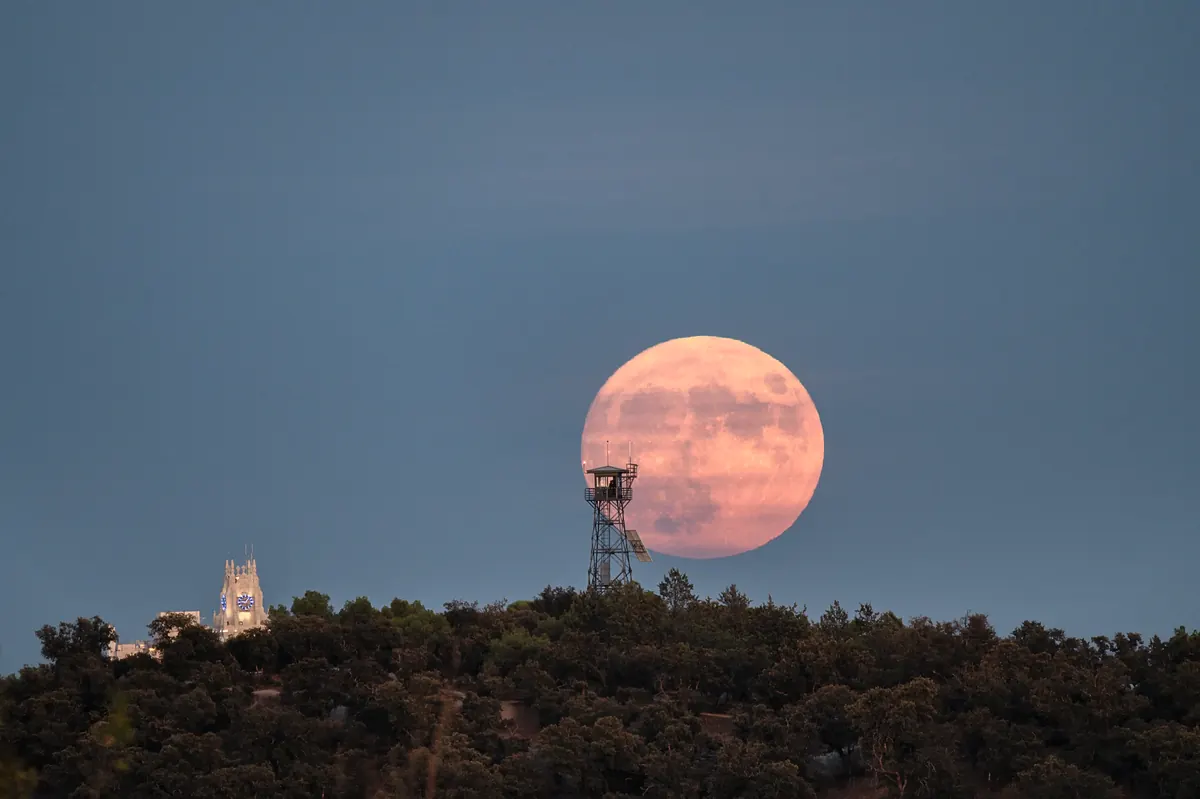
On a clear evening, a full Moon rises behind trees or rooftops and seems almost impossibly large. Within an hour it has climbed higher, and somehow it looks smaller. If the same night happens to be called a supermoon, the temptation is to connect the two events: the Moon must be closer, so it must be bigger. The truth is more interesting. A supermoon is a real orbital event, but the most dramatic part of the show is usually happening in your perception, not in the sky.
What the Word "Supermoon" Really Means
"Supermoon" is a popular label, not a strict astronomical category. It generally refers to a full Moon that occurs near perigee, the point in the Moon's orbit where it is closest to Earth. Astronomers sometimes use the phrase "perigee full Moon," or the more technical "perigee syzygy," but the meaning is the same: the full phase and the close approach line up.
The Moon's orbit is an ellipse, not a perfect circle. That means its distance from Earth changes continuously. Perigee is the closest point, apogee the farthest. A full Moon can occur near either one, or somewhere in between. When it happens near apogee, some people call it a micromoon. The names are convenient labels for a gradual continuum, which is why different calendars and headlines sometimes disagree about whether a particular full Moon qualifies as a supermoon.
Perigee, Apogee, and the Real Size Difference
The Moon's average distance from Earth is roughly 384,000 kilometers. At perigee it is about 356,000 kilometers away; at apogee it is about 407,000 kilometers away. Those numbers are approximate because the orbit is not fixed, but they show the scale. The Moon is not suddenly arriving from another part of the solar system. It is simply following the closer part of its usual path.
Because the Moon is closer at perigee, it does look larger. A full Moon at perigee can appear about 14 percent wider than a full Moon at apogee, with roughly 30 percent more visible area. Compared with an average full Moon, a supermoon may be around 7 percent wider. That is a real optical difference, not an illusion.
It is also a difference that is easy to miss. The human eye is not a precise measuring instrument, especially when the Moon is alone in the sky. Without a fixed reference, a 7 percent change in apparent diameter is subtle. The Moon is also bright, and brightness can make a bright disk seem to bloom against a dark background. If you glance at one full Moon this month and another a few months later, you may not notice the size change at all.
Why the Change Is Easy to Miss
A supermoon does not switch on like a lamp. The Moon's distance changes steadily over days and weeks. The full Moon on the night of perigee may be only slightly larger than the full Moon a month earlier. Clouds, haze, and the Moon's altitude above the horizon affect how large and bright it seems. Memory is unreliable too: the Moon you remember as enormous was probably seen near the horizon, framed by buildings or trees, not measured against a ruler.
Why the Moon Looks Huge Near the Horizon
This is the Moon illusion, and it is one of the most reliable tricks in the sky. When the Moon is low, near the horizon, it often looks much larger than when it is high overhead. Yet the Moon's angular diameter, the actual size of its image in the sky, is essentially the same in both cases. If you photograph the Moon with the same lens and camera settings at moonrise and again when it is high, the lunar disk will be nearly the same diameter in pixels.
Atmospheric refraction can flatten the Moon slightly near the horizon and tint it orange or yellow. It does not magnify the Moon in any meaningful way. The bigger effect is perceptual. Near the horizon, the Moon sits beside familiar objects: trees, hills, buildings, chimneys. Your brain uses those cues to judge distance and scale, and the result is a Moon that feels closer and larger. High in the sky, surrounded by empty space, the Moon has nothing to compare itself with and seems smaller.
There is no single explanation that satisfies every researcher, and the Moon illusion is still discussed in terms of distance cues, framing, and the shape of the perceived sky. For a skywatcher, the practical point is simpler: the horizon Moon is not actually larger. It is the same Moon, placed in a scene that makes it look dramatic.
What Actually Changes During a Supermoon
A full Moon near perigee is genuinely a little larger and a little brighter than an average full Moon. Its gravitational pull is also slightly stronger because it is closer. When perigee coincides with a full or new Moon, tidal range can be modestly enhanced. These are real effects, but they are modest, and local weather, coastline shape, and ocean conditions matter far more for any particular high tide.
What does not change is the Moon itself. It is not growing, swelling, or moving onto a collision course with Earth. The supermoon label describes a point in an orbit, not a new kind of object. It is also not rare enough to justify the breathless tone of some headlines. Full Moons near perigee come around every few months, though not every one is equally close.
How to See a Supermoon for Yourself
The best views usually come around moonrise, when the Moon is low and the sky is still bright enough to show the landscape. You do not need special equipment, but a little planning helps.
- Check the moonrise time and direction. A weather app or astronomy calendar will give you the approximate time and compass direction. Arrive a few minutes early.
- Find a low, clear horizon. A hilltop, a beach, or an open field works well. Buildings and trees can block the Moon at first, though they also provide the foreground that makes the illusion strong.
- Use a fixed landmark. Watch the Moon pass a chimney, a tree branch, or a distant tower. The comparison makes the size easier to judge.
- Bring binoculars. They will not make the supermoon enormous, but they will show craters and maria clearly, especially when the Moon is not too bright for your eyes.
- Photograph it with the same lens and exposure. Take one frame at moonrise and another when the Moon is higher. Compare the lunar disk on your screen. The difference in apparent size will be small.
- Look again later. The Moon will seem to shrink as it climbs. Nothing has changed except your viewing geometry and your brain's interpretation of the scene.
A Measured Way to Enjoy the Spectacle
A supermoon is worth watching, but not because the Moon becomes enormous. It is worth watching because it gives you a reason to notice the Moon's elliptical orbit, to compare one full Moon with another, and to catch the horizon illusion at its most persuasive. Treat the headlines as an invitation rather than a measurement.
If you want to judge the event for yourself, keep the test simple: view the Moon low, then view it high, and photograph both with the same settings. The real size change is there, modest and measurable. The dramatic change is in the scene around it. Knowing the difference makes the sky more interesting, not less.
Photo: Emilio Garcia / Pexels